By Jen Weimer, stewardship assistant
Winter this year was the coldest in decades and snowfall broke records in some areas. After months of snow-covered forests and frozen lakes, the ground is reappearing and the water is flowing. Spring in New England can feel less like a season change and more like an awakening. Suddenly the once quiet mornings have become filled with the familiar sound of song sparrows and the phoebes that nest under my porch eaves every year have just returned. The Eastern Phoebe (Sayornis phoebe) is one of the first birds to return north in the spring and they prefer to nest on human-made structures. Their fee-bee call is a welcome at my home each year and I look forward to watching them raise their young throughout the summer. They are easily recognizable by their active tail-wagging and feeding behavior, repeatedly going back and forth, catching insects in the air.
Spring continues to creep in as the sun lingers longer in the sky and patches of grass push through the melting snow. I can hear the nearby brook – full of snowmelt – rushing like a river, reminding me that it’s a wonderful time to go chasing waterfalls. The John and Rosemarie Calhoun Family Forest in Gilsum has an easily accessible waterfall located along the Porcupine Falls Trail. This property, named for the family that owned this land for half a century, has over 300 acres of sustainably managed forest to explore. This time of year, there are plenty of spring plants and flowers to keep an eye out for when you are on the trail.
One of the first flowers on the scene that appears in spring is Skunk Cabbage (Symplocarpus foetidus), which generates its own heat allowing it to poke through the snow. Found in wet, forested floodplains, it’s named for the strong odor it emits to lure pollinating insects. March weather is moody, going back and forth between spring and winter, but by April, the landscape transforms almost overnight. Buds appear on maple and birch trees and crocuses poke through garden beds. I particularly like when the forests take on a hazy green glow as Canada mayflower (Maianthemum canadense) – an important spring food source for deer – emerges from the brown forest floor.
One unwelcome but important spring appearance to note are invasive plants including Japanese barberry, honeysuckle, garlic mustard, multiflora rose, oriental bittersweet, and knotweeds. These unwanted species often appear before native plants, allowing for early identification and removal before they become a problem. Japanese barberry (Berberis thunbergii) are small shrubs with small oval leaves and sharp thorns. Honeysuckles (Lonicera species) are among the first woody plants to leaf out and form thickets. Garlic mustard (Alliaria petiolate) has green heart-shaped leaves with toothed edges that smell like garlic when crushed. Multiflora rose (Rose multiflora) has arching canes with sharp, curved thorns and distinct fringed stipules at the base of the leaf stalks. Oriental bittersweet (Celastrus orbiculatus) is a woody climbing vine that can grow over shrubs and wrap tightly around trees. The emerging shoots of knotweeds – including Japanese (Reynoutria japonica), Giant (Reynoutria sachalinensis), and their Bohemian hybrid (Reynoutria x bohemica) – resemble bamboo with large heart-shaped leaves.
One springtime favorite of mine are spring ephemerals – early season perennial flowering plants with a short life cycle – such as trilliums, trout lily, and native violets. Like the Canada mayflower, trilliums grow from rhizomes – horizontal underground stems capable of producing roots and shoots. Of the nearly 40 species known to grow in North America, the red trillium (Trillium erectum) is the most common in New Hampshire – the other two are painted (Trillium undulatum) and white trillium (Trillium grandiflorum). They all thrive in shady, moist, deciduous forests with rich well-drained soils. Characterized by a whorl of three leaves and a single flower with three petals, trilliums are very fragile and picking them can kill the entire plant. The leaves of trout lily (Erythronium americanum) are mottled – resembling trout markings – and sit at the base of a small stalked single yellow flower with back-bending petals. Another yellow flower blooming in early spring is the round-leaved yellow violet (Viola rotundifolia). Look for clumps of oval-round leaves close to the ground with small yellow flowers.
But nothing excites me more this time of year than hearing peepers for the first time. Spring peepers (Pseudacris crucifer) are cold-tolerant frogs that hibernate under logs and tree bark all winter surviving by converting glycogen to glucose, which acts as a natural antifreeze. They wake up when nighttime temperatures consistently reach at least 40 degrees Fahrenheit and their chorus grows louder on warmer and wetter evenings as they begin to breed. Listen for them in the evenings near vernal pools and other temporary wet marshes and ditches where they breed. They will go quiet again if temperatures dip back below freezing but will return when it warms up.
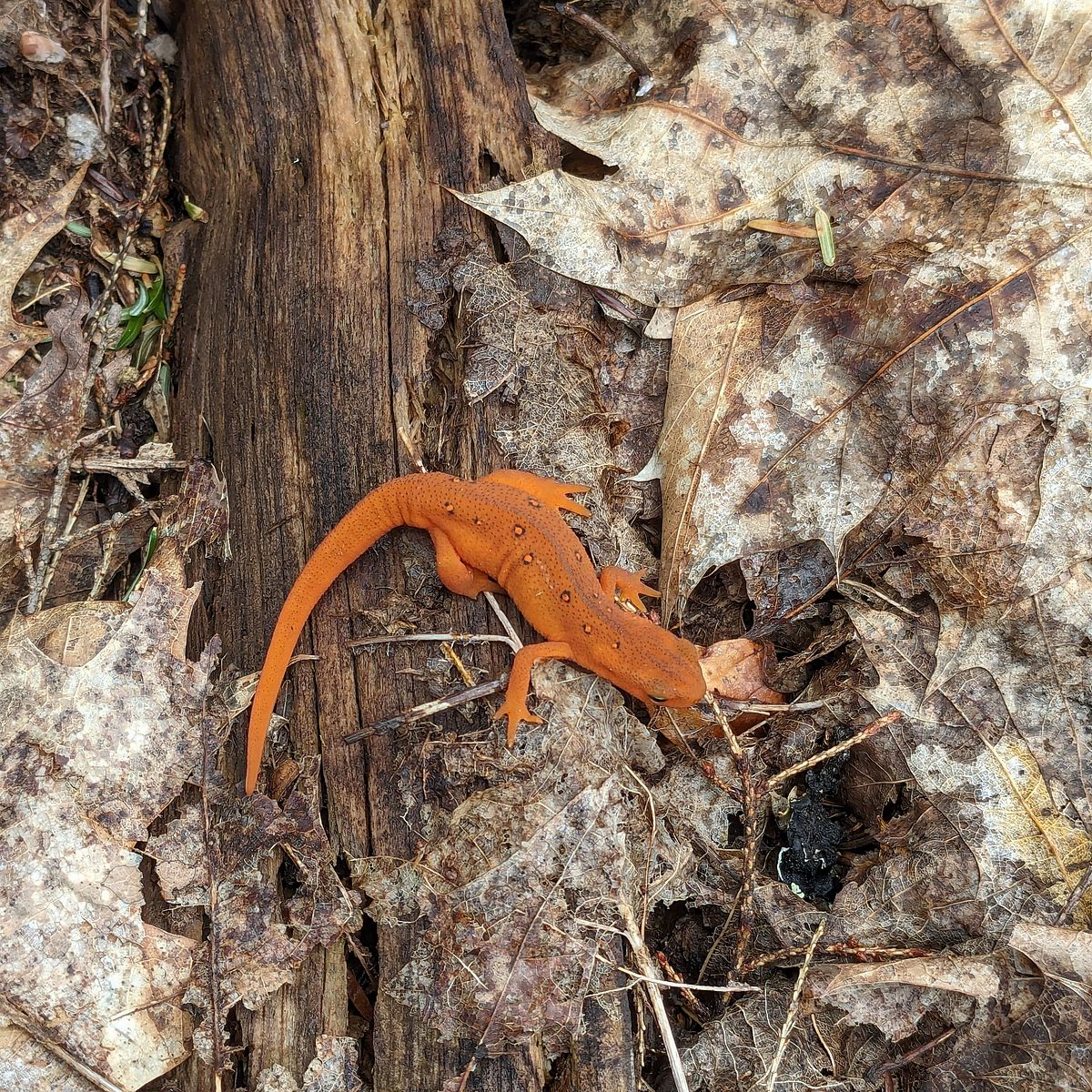
Another cold-blooded creature that brightens up the spring forest is the eastern newt (Notophthalmus viridescens) – specifically the juveniles known as red efts. Adults are aquatic and breed from late winter to early spring. Gilled larvae transform into terrestrial juveniles – efts – which are bright orange with spots. Efts are easy to spot after spring rains and can live on land for many years before returning to the water as adults.
If you’re a hiker, it’s time to dust off those hiking boots that you abandoned in the corner all winter. Prepare for muddy paths and lingering patches of snow and ice. Our popular Cheshire Walkers hikes are returning in late April on Tuesday mornings. This year we will be exploring Tippin Rock in Swanzey, Glover’s Ledge in Langdon, Cranberry Meadow Pond in Peterborough, Converse Meadow in Rindge, Porcupine Falls in Gilsum, and the Harris Center’s East Side Trails. These hikes are perfect for seniors or anyone who prefers a slower pace. Sign up and wake up those hiking feet with us, it’s spring!